DIY Aircon Filter Cleaning vs Professional Servicing
DIY filter rinsing has a place — but it can't reach the coil, blower, or drainage pipe. Here's what only professional aircon servicing can do in Singapore.
We frequently get asked to compare diy aircon cleaning vs professional servicing. The reality is that air conditioners consume up to 60% of household electricity in Singapore.
Proper care is essential to keep your monthly bills under control. Our team at Coolbest Aircon Servicing has seen the results of both excellent and poor maintenance habits. You will find that DIY tasks, when done correctly, help your unit run better between professional visits.
But homeowners often ask the wrong question.
We find the real issue is understanding what each method actually achieves, and where one ends and the other begins. Here is the honest map to guide your maintenance schedule.
What DIY can do well
There are two maintenance tasks any homeowner can, and should, do themselves. This direct approach saves money and prevents immediate efficiency losses.
1. Monthly filter rinse
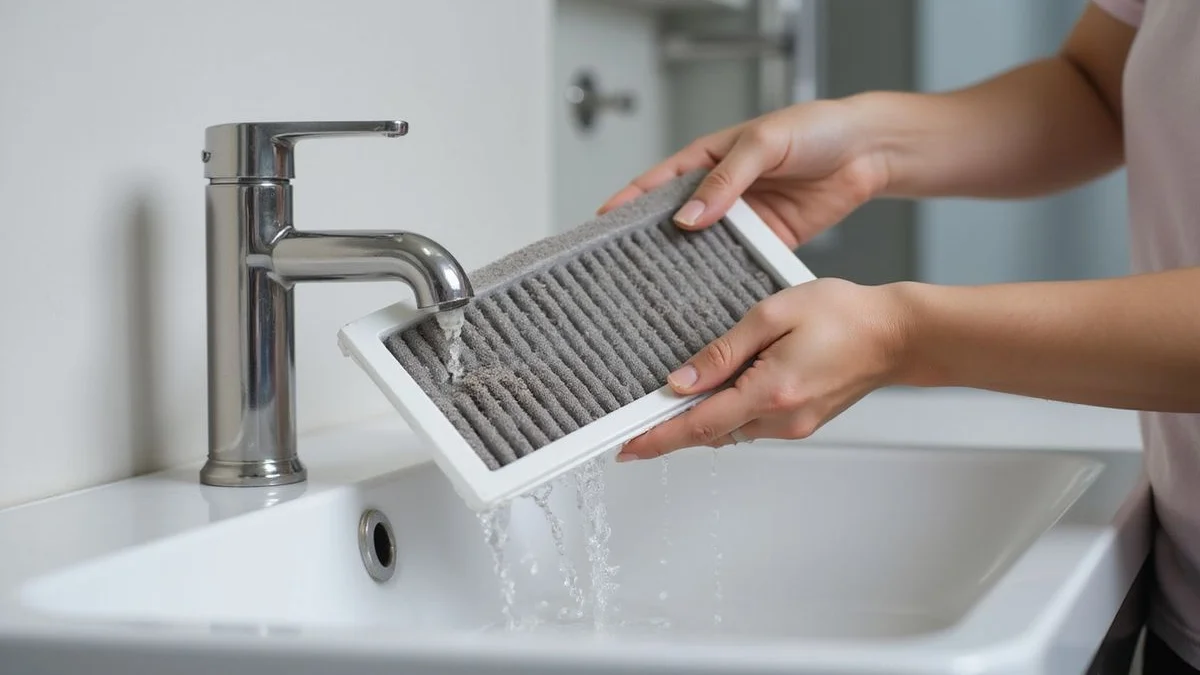
Pop the front cover, slide out the filter, and rinse it under tepid running water with light finger brushing. Let it dry fully for at least 30 minutes in a shaded spot before reinstalling. A clean filter restores airflow and extends the filter’s own life.
Our experts note that a neglected filter in Singapore’s humid climate drops cooling efficiency by up to 15%. This simple rinse can save you between S$50 and S$100 on your yearly electricity bill in a typical 4-room HDB flat.
2. Monthly cover wipe
Wipe the external plastic fascia with a damp microfibre cloth. Dust does not hurt performance much when it is on the outside, but it ends up pulled inside if you do not remove it.
We strongly recommend this step because high humidity and local construction dust cause rapid surface buildup. Any dust left on the cover will eventually migrate into the sensitive internal parts.
That is the complete DIY checklist. Anything beyond these two steps, including the at-home chemical sprays you will see on Shopee, runs real risks.
What DIY can’t reach (and shouldn’t try)
Certain internal components require specialized tools and technical knowledge. Attempting to clean these parts yourself often leads to expensive damage.
The evaporator coil
This is where 90% of cooling happens, and where 90% of efficiency loss hides. The coil sits behind the filter and blower, arranged in a tight aluminium stack of thin fins.
Our technicians find that a mere 0.02-inch dust layer on this coil reduces heat transfer efficiency by 15%. Laboratory tests also show that dust and biofilm increase the coil surface temperature by up to 8°C.
Coil cleaning requires one of the following professional methods:
- Chemical spray applied at the right concentration and angle, as consumer sprays are too weak or too strong.
- High-pressure water flush from a calibrated nozzle.
- Dismantling the unit to access the coil directly.
Home attempts usually bend the fins permanently, which reduces the heat-transfer area. You also risk soaking electrical components you cannot see.
The blower wheel
The squirrel-cage fan spinning inside the fan coil is crucial for air circulation. It accumulates thick, sticky dust over months, which is often the single biggest cause of airflow loss.
“A dirty blower wheel is often the single biggest cause of sudden airflow loss in residential air conditioners.”
We tackle this by completely removing the wheel from its shaft during a dismantle job. Professional alkaline-based cleaning solutions are required to dissolve the compacted dirt and grease that water alone cannot penetrate.
Trying to scrub this fan while it is still mounted will unbalance the blades. An unbalanced wheel causes severe vibration and ruins the motor bearings.
The drainage system
Mould and biofilm grow inside the drainage pipe and tray, where you cannot see them. A clog here causes water leaks later, which is the top cause of aircon trunking leaks in Singapore HDB flats.
Our standard procedure uses compressed air and a specialized drainage flush line to clear these blockages. Flushing the drainage from outside with garden-hose water simply does not reach the deep clogs.
Over time, untreated algae and debris completely obstruct the flow of condensation. When the water backs up, it overflows the drain pan and escapes into your room.
Common signs of a severe drainage clog include:
- Blinking error lights on the indoor unit panel
- Musty or mouldy smells coming from the vents
- Visible water pooling directly beneath the fan coil
Electrical and control parts
This category includes several high-voltage components:
- Printed Circuit Boards (PCBs)
- Starting and running capacitors
- Fan motors and thermistors
Touching any of these without power isolation is a genuine electrical risk.
We urge homeowners to stay away from these components due to Singapore’s standard 230V residential power supply. Capacitors can store a dangerous electrical charge even after the main circuit breaker is turned off.
Please do not attempt to clean or adjust these parts. A single drop of water on a live PCB will short-circuit the entire system instantly.
The honest frequency math: diy aircon cleaning vs professional
Even if you rinse the filter every single week, your professional servicing cadence only extends slightly. This happens because coil and blower fouling occur regardless of filter cleanliness.
Our data clearly shows how different habits impact the long-term health of your system. Review the comparison below to see exactly what you save and what you sacrifice.
| Maintenance pattern | What it saves | What it doesn’t |
|---|---|---|
| Monthly filter rinse only | Airflow between services | Coil fouling still happens |
| DIY + 6-monthly pro service | Most cooling efficiency | Chemical overhaul still needed every 1-2 years |
| DIY + 3-monthly pro service | Near-factory efficiency | Unit still ages normally |
| Nothing (skip all servicing) | Nothing | You will pay in repair + overhaul within 18 months |
The cost of skipping
Homeowners who skip professional servicing for over two years invariably face severe consequences. You will end up in one of three highly undesirable situations.
We frequently replace parts that could have been saved with basic maintenance. The financial impact of neglect is steep in the local market.
- A chemical overhaul at significantly higher cost than bundled standard services
- A drainage leak that damages ceiling or wall paint
- A compressor failure from running against clogged coils
The arithmetic is unforgiving in 2026. A standard servicing visit costs between $30 and $50 per unit, while a full chemical overhaul ranges from $150 to $300.
A skipped year of servicing usually costs three to four times what the basic maintenance would have cost.
Our recommendation
When weighing diy aircon cleaning vs professional maintenance, we strongly advise doing the DIY filter rinse monthly to maintain steady airflow. You should also book professional servicing every three to six months.
Scheduling a chemical wash every one to two years is the next vital step. That is the exact pattern that keeps Singapore aircons running their full 10-year lifespan.
Our team is ready to help you establish a routine that protects your investment. Reach out via WhatsApp to get on a rhythm that works perfectly for your household.
Questions Answered
Frequently Asked Questions
Can I just rinse the filter every month and skip servicing?
No. Filter rinsing extends filter life and keeps airflow reasonable, but the coil, blower wheel, and drainage pipe still foul up and need professional cleaning. Think of filter rinsing as brushing your teeth — necessary daily maintenance, but not a replacement for a dentist.
What happens if I open the fan coil myself?
You risk bending the coil fins (which reduces cooling forever), voiding the manufacturer warranty, and exposing yourself to sharp edges and electrical risk. Modern fan coils also have plastic clips that break if opened wrong. Dismantling is a technician job.
How much more effective is professional servicing?
Significantly. Coil fouling accounts for most efficiency loss in a household aircon, and the coil sits behind the blower where home cleaning can't reach. Filter rinsing helps with the first 10%; professional servicing gets the other 90%.
 LICENSED
 About the Author
Mr Chong
Founder & Licensed HVAC Technician, Coolbest Aircon
Mr Chong founded Coolbest Aircon in Jurong after more than 18 years in Singapore’s HVAC industry. He started as an apprentice technician on HDB rooftops, moved into commercial chiller work, then built Coolbest to offer honest, diagnostics-first aircon servicing across the West. He holds a BCA-licensed contractor registration, NEA-certified refrigerant handler status, and personally trains every technician on the team. Mr Chong writes these guides to answer the same questions he hears on every job call.
Related Guides
What's Included in a Standard Aircon Servicing?
Exactly what Coolbest Aircon's S$50–S$115 per-unit servicing covers in Singapore: filter wash, coil wipe, drainage flush, blower, vacuuming. No surprises.
Read guide →How Often Should You Service Your Aircon in Singapore?
The right aircon servicing cadence for Singapore's tropical climate. Coolbest Aircon explains when HDB, condo, and heavy-use units need a professional visit.
Read guide →Signs Your Aircon Needs Professional Servicing
Weak airflow, rising bills, musty smell, or water marks? These are the signs your aircon needs professional servicing before the problem becomes a repair.
Read guide →Ready for cool, clean air — today?
Chat with Coolbest on WhatsApp for same-day aircon service in the West.