How to Choose the Right Aircon for Your Singapore Home
Choosing a new aircon in Singapore? BTU sizing by room, inverter vs non-inverter, brand reliability, system type, tick rating. Practical buyer's guide.
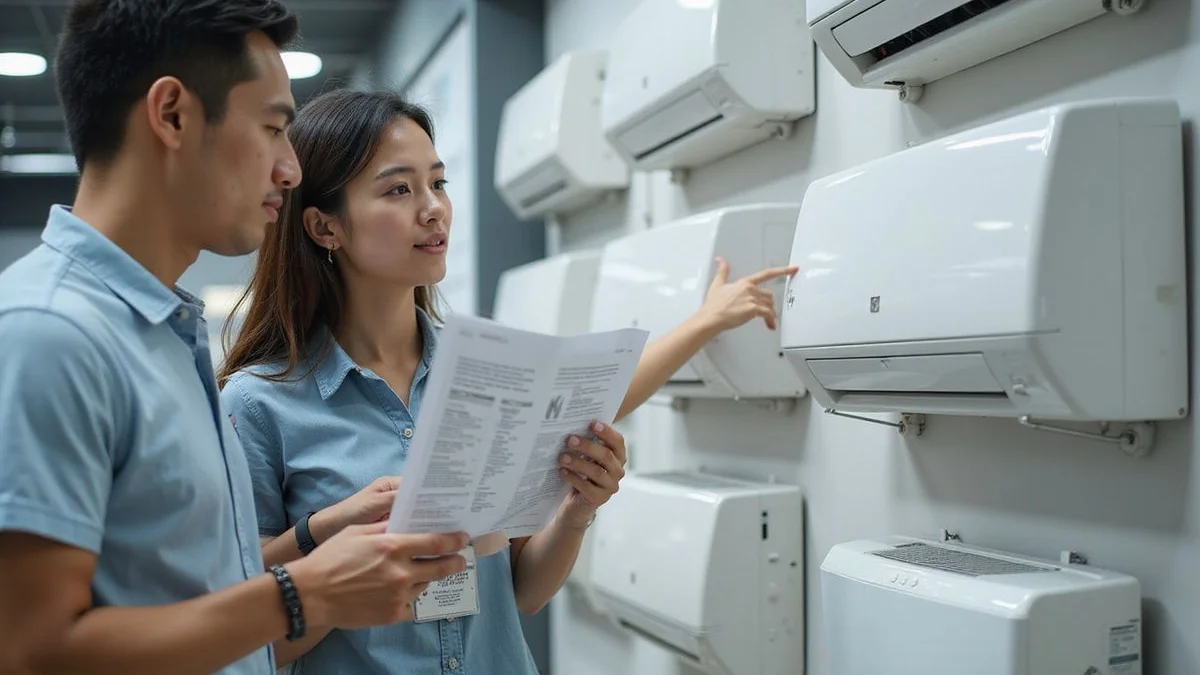
Figuring out how to choose aircon singapore setups correctly dictates your daily comfort and long-term utility costs. A poorly sized unit forces the compressor to run constantly, inflating electricity bills unnecessarily.
We have structured this practical walkthrough to guide you through the essential decisions in the exact order you need to make them. This covers everything from precise BTU sizing to brand selection and energy efficiency ratings.
Our team will also explain the importance of specific system types and essential hardware features worth paying for. You will learn how to make a data-driven choice to secure reliable, high-quality cooling for your residence.
Step 1: BTU sizing (most important single decision)
A precise BTU (British Thermal Unit) calculation ensures your air conditioner cools the room efficiently without wasting power. You must match the unit’s capacity directly to the square metreage of the specific room.
Too small: The unit runs constantly and never reaches the target temperature. This results in a short lifespan, a high electricity bill, and poor comfort.
Too large: The compressor cycles on and off too rapidly. The system fails to dehumidify the air properly, making clothes and walls feel clammy from repeated starts.
Right size: Matched perfectly to the room dimensions.
HDB / condo guideline table
| Room type | Typical area | Recommended BTU |
|---|---|---|
| Single bedroom / study | 8-12 sqm | 9000 BTU |
| Master bedroom | 13-18 sqm | 12000-13000 BTU |
| Large master / combined bedroom | 19-24 sqm | 18000 BTU |
| Living room (small HDB) | 18-22 sqm | 18000 BTU |
| Living + dining (open-plan) | 25-35 sqm | 24000 BTU |
| Large living (condo, landed) | 35-50 sqm | 28000-30000 BTU |
Current 2026 data shows 9,000 BTU is standard for a typical bedroom, while open-concept living areas demand at least 24,000 BTU. Undersizing a unit by just 20% forces the compressor to skip its idle phase entirely.
This single mistake can increase your daily energy consumption by over 15%.
Add capacity if:
- Top floor or west-facing unit (+15-20%)
- Lots of windows or glass panels (+10-15%)
- Ceiling higher than 2.6 metres (+10%)
- Room has hot appliances like an oven or server rack (+10-20%)
- Used by more than two people regularly (+10%)
Reduce capacity if:
- Ground floor and well-shaded area
- Very short duration use only
Our technicians perform a professional site survey to get the exact BTU right. Generic advice based on what a neighbour uses frequently leads to mis-sized installations.
Step 2: System type
The ideal system type depends entirely on your available outdoor ledge space and the number of rooms requiring climate control. Multi-split configurations remain the standard for modern Singapore flats due to strict space constraints.
Single-split (one indoor, one outdoor)
Best for: Bedrooms, small rental properties, or replacing a failed single unit.
Pros: Simplest setup, cheapest cost per BTU, fastest to install, and easiest to repair. Cons: Each indoor unit needs its own outdoor compressor, which poses a problem if you have multiple rooms and limited outdoor ledge space.
Multi-split (one outdoor, 2-5 indoor)
Best for: HDB and condo flats with three to five aircon rooms and limited outdoor ledge space.
Pros: One outdoor unit serves two to five indoor units, saving valuable exterior space. The Housing & Development Board (HDB) limits external installations to a maximum of two split-type condensing units, making this a common choice. Cons: Higher upfront cost, and if the single outdoor unit fails, all connected indoor units stop working. It also requires a more complex installation process.
Window units (single-window install)
Rare in modern Singapore and mostly replaced by split systems. These are still used in some older HDB flats and rental units.
Pros: Cheapest to buy, simple to install, and no outdoor unit is needed. Cons: Noisy indoors, less efficient, limited BTU range, and creates a visual impact on the window.
Ducted / cassette (ceiling-concealed)
Best for: High-end condos, landed properties, and commercial spaces.
Pros: Invisible when installed, offers even air distribution, and delivers a premium feel. Cons: Much higher cost, requires a false ceiling, demands specialist installation, and is harder to service.
We highly recommend the multi-split configuration for typical HDB and condo homes across the country. This setup adheres to local ledge weight limits, which cap the maximum load at 110kg per wall panel.
Step 3: Inverter vs non-inverter
Inverter technology serves as the most cost-effective choice for any room requiring consistent climate control. These systems use a variable-speed compressor to maintain temperatures without wasting power.
| Compressor Type | How It Works | Energy Savings |
|---|---|---|
| Inverter | Adjusts output continuously, holding temperature with small adjustments. | Uses 30% to 50% less electricity. Modern R32 units offer superior efficiency. |
| Non-inverter | Fixed-speed compressor that repeatedly cycles fully on and off. | Cheaper upfront by S$150 to S$300 per unit, but costs more to run long-term. |
Our primary recommendation is an inverter model for any space used more than four hours a day. Non-inverter setups make financial sense only for very light-use rooms where the upfront savings outpace the daily electricity costs.
You can read our detailed inverter vs non-inverter guide for the full comparison.
Step 4: Brand
Selecting the right manufacturer guarantees access to replacement parts and reliable after-sales support. We group the major air conditioning brands in Singapore by their typical market positioning and core strengths.
Premium reliability
- Daikin: A Japanese industry benchmark for durability with excellent parts availability and premium pricing. The flagship Daikin iSmileEco Series features smart app controls, a 5-tick efficiency rating, and a PM2.5 filter.
- Mitsubishi Electric: A Japanese brand known for being extremely reliable with excellent dehumidification. The popular Starmex GP or FP Series is famous for its ultra-quiet 19dB operation and Dual Barrier Coating.
Strong mid-tier
- Panasonic: A Japanese manufacturer delivering good quality, Nanoe air-purification features, and widely available parts.
- Toshiba: A Japanese brand offering reliable performance and good efficiency. This option sometimes provides better value than Daikin or Mitsubishi.
- LG: A Korean competitor with strong inverter technology, modern features, and competitive pricing.
Budget tier
- Midea, Hisense: Chinese brands offering lower costs. Midea’s All Easy Pro series provides affordable 5-tick efficiency for budget-conscious buyers.
We prefer Daikin and Mitsubishi for main living areas and master bedrooms. Toshiba and Panasonic serve as excellent second-tier choices for guest rooms.
You will find a full brand comparison in our best aircon brands guide.
Step 5: Energy efficiency (ticks)
The National Environment Agency (NEA) issues Energy Labels to help consumers calculate long-term running costs accurately. Higher tick ratings reduce your monthly utility bills drastically in Singapore’s tropical climate.
The NEA Energy Label displays a visual scale from one to five ticks based on the Cooling Seasonal Performance Factor (CSPF).
- 1-2 ticks: Represents minimum compliance and should be avoided for any room used regularly.
- 3 ticks: An acceptable baseline for most standard bedrooms.
- 4 ticks: A solid choice that provides a good efficiency-to-price ratio.
- 5 ticks: The premium efficiency tier that pays back quickly over years of heavy use.
We recommend checking the Cooling System Calculator on the NEA Life SG page to compare specific models. As of early 2026, the average SP Group household electricity tariff sits around 29.7 cents per kWh.
Based on these rates, a 5-tick inverter typically costs S$100 to S$300 more than an equivalent 3-tick model upfront. A premium 5-tick unit saves roughly S$145 annually compared to a standard 3-tick system. For heavy-use rooms, the higher purchase price pays for itself in just three to four years.
Step 6: Features worth paying for
Modern cooling systems offer dozens of optional upgrades, but only a few provide measurable financial or operational value. Focus your budget on features that lower maintenance costs or reduce daily electricity consumption.
Genuinely useful
- Self-clean mode: Runs the fan after shutoff to dry the internal coil. This simple function reduces biofilm growth and extends the time between chemical washes.
- WiFi / app control: Allows you to schedule cooling from your phone. This is especially useful for pre-cooling your living room before arriving home.
- Motion sensor / occupancy: Adjusts the output automatically when nobody is in the room to generate real electricity savings.
- Dual Barrier Coating: Found on models like the Mitsubishi Starmex, this coating prevents dust and greasy dirt from sticking to internal parts.
Nice but not critical
- Air purification: Systems like Nanoe or Plasmacluster offer marginal benefits and are often overmarketed. A dedicated PM2.5 Microparticle Catching Filter is helpful, but it cannot replace a standalone air purifier.
- Voice control: Google or Alexa integration provides convenience, but a standard WiFi app achieves the exact same result.
- Powerful cool / jet cool: Fast ramp-up modes are useful, but standard inverters perform this function naturally.
Marketing that doesn’t matter much
- “Tropical” or “Singapore edition” labels: These are usually the exact same units sold elsewhere, just with a localized sticker.
- Mold-resistant coatings: These treatments are useful, but you still need a professional chemical wash every two to three years anyway.
Step 7: Warranty
A comprehensive warranty protects you against premature component failures and unexpected repair bills. Most manufacturers require verifiable proof of regular maintenance to keep these agreements valid.
Standard brand warranties in Singapore include specific coverage periods:
- Compressor: 5 years standard, though some premium brands extend this to 10 years.
- Parts: 1 year standard across most major manufacturers.
- Labour: Typically 1 year from the independent installer, which is completely separate from the brand warranty.
Our Coolbest installation service includes a 90-day workmanship warranty covering installation-related issues like leaks, tilt, drainage, and wiring. The brand warranty runs separately on the hardware unit itself. You must retain your service records, as manufacturers can void the compressor warranty if you fail to perform yearly chemical maintenance.
Step 8: The installer (not just the unit)
A premium air conditioner installed poorly will always perform worse than a mid-tier unit installed correctly. The materials and technical skills provided by your contractor matter just as much as the hardware brand you select.
Our installers strictly recommend thicker SWG 22 (0.71mm) copper pipes for all new installations. Modern R32 refrigerant operates at much higher pressures than older gases. Using cheaper, thinner SWG 23 (0.61mm) piping carries a much higher risk of bursting or leaking over time.
You must also ensure the contractor uses 1/2-inch Armaflex Class 0 insulation to prevent severe condensation in Singapore’s high humidity.
Questions to ask any prospective installer:
- Do you perform a physical site survey before quoting, or do you quote blindly from a photo?
- Are your technicians BCA-trained and certified?
- What is your precise workmanship warranty period?
- Will you pressure-test the new refrigerant lines before commissioning the system?
- Do you handle HDB permit processing and submit the SP Services Ltd Form CS/5H for new electrical wiring?
- Do you supply rust-resistant Grade SS 304 stainless steel brackets for external wall mounting?
Typical all-in costs to consider when learning how to choose aircon singapore (2026)
Total installation pricing depends on the number of indoor units, the energy efficiency rating, and the quality of the raw materials used. Upgrading to thicker copper pipes and premium insulation usually adds a necessary slight premium to the base quote.
| Configuration | Unit + install |
|---|---|
| Single-split 9000 BTU 3-tick | S$900 - S$1,400 |
| Single-split 9000 BTU 5-tick inverter | S$1,200 - S$1,800 |
| Multi-split 2-indoor (bedroom + master) | S$2,500 - S$3,800 |
| Multi-split 4-indoor (full flat) | S$4,500 - S$7,500 |
| 5-tick premium multi-split 4-indoor | S$6,500 - S$10,000 |
We advise budgeting an extra S$100 to S$200 if you choose to upgrade the entire system to SWG 22 copper piping. Contractors may also charge a small dismantling fee of S$50 to S$100 to remove and dispose of your old unit safely.
Our full quotation process takes only 20 to 30 minutes on-site. WhatsApp us your flat type, total room count, and rough dimensions for a quick ballpark figure to start the planning process.
You can view our installation service details for a complete breakdown of our site survey and installation scope.
We know that learning how to choose aircon singapore options requires careful attention to sizing, efficiency, and installation standards. Upgrading to a modern, 5-tick inverter system secures years of quiet, reliable comfort while minimising your monthly utility bills. Our team is ready to help you finalise your decision with a professional site assessment. Contact us today to schedule your consultation and secure the perfect climate control solution for your space.
Part of the Aircon Installation guide hub
← Back to the main Aircon Installation pageQuestions Answered
Frequently Asked Questions
What BTU do I need for a Singapore bedroom?
Standard HDB bedroom (9-12 sqm): 9000 BTU. Master bedroom (13-18 sqm): 12000-13000 BTU. Living room (20-30 sqm): 18000-24000 BTU. These assume average insulation and not a top-floor unit. Top-floor or west-facing rooms need 15-20% more.
Do I really need an inverter aircon?
For any room you use more than 4 hours daily, yes — the electricity savings (15-30%) pay back the price premium within 2-3 years. For a guest bedroom used 20 nights a year, non-inverter may still make sense on upfront cost.
What tick rating should I look for?
NEA ticks 1-5 show energy efficiency. Minimum 3 ticks for any bedroom use. 4-5 ticks for living rooms and heavily-used bedrooms. The price difference between 3-tick and 5-tick usually pays back within 3-4 years in electricity savings.
 LICENSED
 About the Author
Mr Chong
Founder & Licensed HVAC Technician, Coolbest Aircon
Mr Chong founded Coolbest Aircon in Jurong after more than 18 years in Singapore’s HVAC industry. He started as an apprentice technician on HDB rooftops, moved into commercial chiller work, then built Coolbest to offer honest, diagnostics-first aircon servicing across the West. He holds a BCA-licensed contractor registration, NEA-certified refrigerant handler status, and personally trains every technician on the team. Mr Chong writes these guides to answer the same questions he hears on every job call.
Related Guides
Inverter vs Non-Inverter Aircon: Which Is Worth It?
Inverter aircon premium worth it in Singapore? 15-30% lower electricity, payback period, noise, lifespan. Full comparison with our honest recommendation.
Read guide →Split vs Window vs Multi-Split Aircon: Which System Type?
Split, window, or multi-split aircon for your Singapore home? Pros, cons, costs, ideal use case for each. How to decide.
Read guide →Best Aircon Brands for HDB and Condo in Singapore
Daikin, Mitsubishi, Panasonic, Toshiba, LG compared for Singapore HDB and condo use. Reliability, efficiency, service network, parts availability.
Read guide →Ready for cool, clean air — today?
Chat with Coolbest on WhatsApp for same-day aircon service in the West.