Steam Cleaning vs Chemical Wash for Aircon: Honest Comparison
How steam cleaning compares to chemical wash for Singapore aircons: effectiveness on mould and coil deposits, cost, when each is enough. Coolbest's honest take.
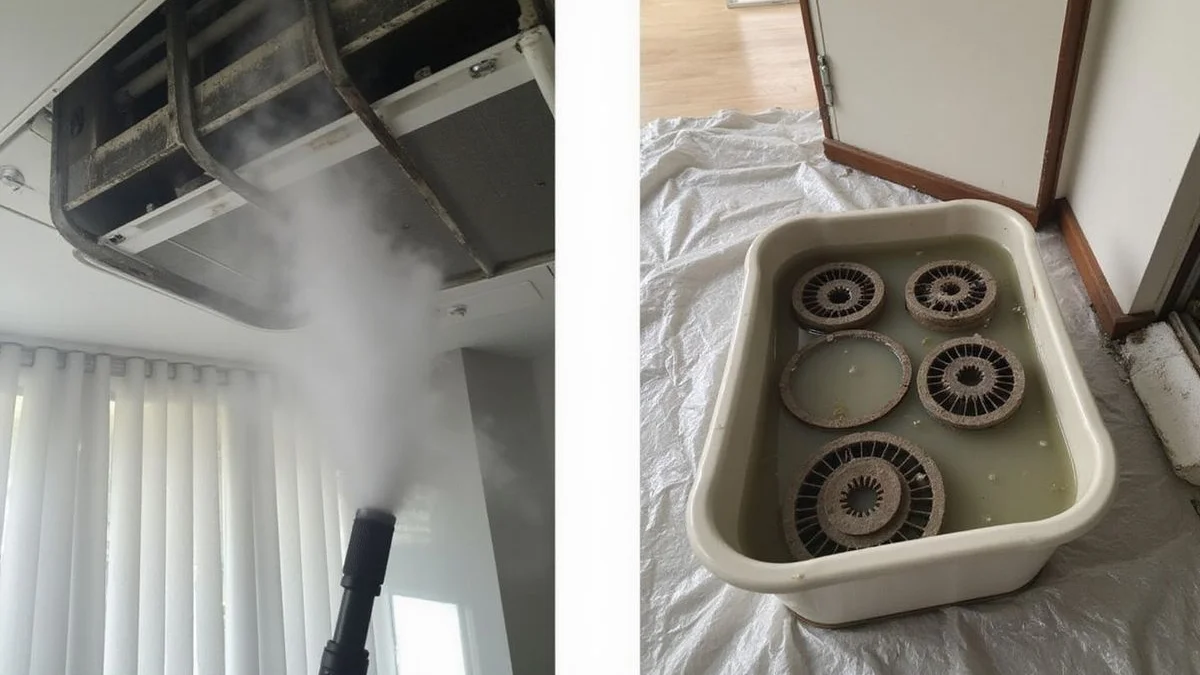
When comparing steam cleaning vs chemical wash aircon services, marketing materials sometimes frame these methods as equivalent. Other times, companies position steam as superior because it uses no chemicals.
This understandable marketing creates confusion for homeowners trying to maintain good indoor air quality. Singapore experiences an average relative humidity of 80 percent. This constant moisture allows mould to germinate inside an air conditioner in just 12 to 24 hours.
You need an honest engineer’s comparison to protect your equipment.
Here is a clear breakdown of both methods to help you make the right choice.
How each method actually works
Each method relies on a different mechanism to remove dirt from your system. Steam uses brief thermal shock, while chemical washing relies on molecular dissolution.
Steam cleaning
Steam cleaning uses a high-temperature wand to blast hot vapour at the aircon coil and blower. Technicians typically use steam guns operating at 150°C and 60 to 100 psi. The theory suggests that hot vapour loosens dust and grime. Technicians then wipe or vacuum the debris away.
What it does well:
- Loosens dry surface dust from the filter.
- Kills some surface bacteria thermally through brief 150°C exposure.
- Removes light grease deposits.
- Avoids chemical residue completely.
What it does not do well:
- Fails to penetrate thick biofilm matrices.
- Bacterial slime remains physically resilient to brief heat exposure.
- Fails to dissolve embedded mineral deposits.
- Leaves hidden parts like the blower interior and drainage pipe dirty.
- Condenses into water during application, which can soak electrical components.
Chemical wash
A chemical wash requires technicians to dismantle the unit and soak components in a calibrated alkaline solution. This targeted solution dissolves oxide layers, bacterial biofilm, and organic deposits.
A simple 100-micron biofilm layer reduces cooling heat transfer by 98 percent. The chemical targets this exact polysaccharide matrix. Technicians then rinse the parts with a high-pressure water jet before reassembly.
What it does well:
- Penetrates biofilm chemically, breaking it down at the molecular level.
- Removes mould spores throughout the entire component, not just the surface.
- Dissolves oxide corrosion products that cause long-term coil degradation.
- Cleans dismantled parts like the blower wheel and drainage tray perfectly.
- Combines high-pressure mechanical removal with chemical loosening.
What it does not do well:
- Takes two to three times longer than a steam service.
- Requires high technician skill to execute safely without causing damage.
- Costs significantly more for the consumer.
- Corrodes the delicate coil if an over-strong solution is poorly rinsed.
Effectiveness on the things that actually matter
Chemical washing severely outperforms steam when treating deep contamination like mould and biofilm. Singapore’s warm 25°C to 30°C daily average creates the perfect breeding ground for moisture issues.
Steam handles recent and surface-level problems well. Chemical washing handles established and deep problems successfully.
| Contamination type | Steam cleaning | Chemical wash |
|---|---|---|
| Light surface dust | Good | Good |
| Packed dust in filter | Excellent | Excellent |
| Surface grease from cooking | Moderate | Good |
| Bacterial biofilm | Poor | Excellent |
| Visible mould colonies | Poor | Excellent |
| Drainage pipe slime | None (not reached) | Excellent |
| Embedded mineral deposits on coil | Poor | Good |
| Oxide corrosion layers | None | Good |
| Restoring heat transfer efficiency | Moderate | Excellent |
Cost and time
Steam cleaning serves as a middle-tier service in both price and thoroughness. In 2026, Singapore market rates show a clear divide between these two maintenance options.
- Steam cleaning: This service typically requires 45 to 60 minutes per unit. Current 2026 pricing usually falls between $80 and $150 SGD.
- Chemical wash: This process requires a full dismantle taking 90 to 120 minutes per unit. Pricing for a proper dismantle chemical wash ranges from $130 to $180 SGD.
Steam costs more than standard general servicing. It costs less than a full chemical overhaul.
When steam is a reasonable choice
Steam works very well as an appropriately scoped preventive measure. We recommend steam for specific, well-maintained scenarios.
- The unit has light-to-moderate usage of 3 to 5 hours daily.
- No mouldy or musty smells exist in the room.
- The unit operates on a regular maintenance schedule already.
- The primary problem involves surface dust rather than biofilm.
- You are completing an annual deep clean on a well-maintained system.
Many Coolbest customers do not require a chemical wash every single year. Alternating two standard services with one steam or chemical wash works perfectly for them.
When steam is the wrong call
Steam fails to resolve deep-seated issues like established mould, leaks, or severe blockages. A 2025 energy study showed that a 100-micron biofilm drops cooling capacity drastically. Steam simply cannot penetrate this barrier.
- There is confirmed mould, a mouldy smell, or a water leak.
- The unit is over 5 years old and has never had a chemical wash.
- The drainage tray is visibly slimy with algae.
- You noticed a drop in cooling that persists after a standard service.
- You are trying to buy time on an aging unit.
You will waste money using steam in these situations. A full chemical overhaul is the correct scope to extend the unit’s lifespan.
Coolbest’s honest recommendation framework
We use a simple decision tree to help customers choose the right service. This framework ensures you never pay for unnecessary work. Our team evaluates four main criteria before proceeding.
- Is there a symptom like a smell, mould, or leak? Choose a chemical wash.
- Has it been more than 2 years since any deep clean? Choose a chemical wash.
- Is the unit 5+ years old with no history of chemical washing? Choose a chemical wash.
- Is the unit well-maintained with no symptoms? Either steam or chemical wash works well.
We recommend a chemical wash every second preventive cycle. This targeted approach keeps your hardware functioning efficiently. We offer chemical washes instead of steam at Coolbest because we only provide services suitable for our own families. Any unit needing a genuine deep clean requires a chemical wash in our professional opinion.
The “no chemicals” marketing
Some steam-cleaning providers market a lack of chemicals as a major safety benefit. Let us look at the facts behind this specific marketing claim.
The chemical solution used in a proper wash is non-toxic after rinsing. It does not leave any residue that contacts your breathing air. Professional alkaline coil cleaners are chemically similar to the detergents used in commercial dishwashers and hospital sterilisation systems.
Proper rinsing brings the pH level back to neutral immediately. This process easily meets the National Environment Agency SS 554 indoor air quality standards. The true danger comes from inexperienced technicians applying the wrong solution strength, not the chemicals themselves.
Book what matches your situation
You should select the service that directly addresses your unit’s current condition. A well-done steam clean by a reputable provider is fine for symptom-free units on a regular cadence.
You need a deeper clean if you notice odours or a drop in performance. Reach out to us on WhatsApp and book a chemical wash.
Our team will tell you honestly which scope is right for your home to settle the steam cleaning vs chemical wash aircon debate once and for all.
Part of the Aircon Chemical Wash guide hub
← Back to the main Aircon Chemical Wash pageQuestions Answered
Frequently Asked Questions
Is steam cleaning as good as chemical wash?
For surface dust and light grime, yes — steam can be very effective. For biofilm, mould colonies, and deep coil deposits, chemical wash is materially more effective because it combines chemistry (which breaks down biofilm) with mechanical removal (high-pressure flush).
Why do some providers only offer steam cleaning?
Steam is faster, requires less dismantling, and has a lower equipment cost. It's a legitimate service for the right situation — it's just not a drop-in replacement for chemical wash when the problem is mould or biofilm.
Can I do steam one year and chemical wash the next?
Yes — alternating is a reasonable strategy for moderately-used units with no active mould symptoms. If you have confirmed mould, musty smell, or water leak symptoms, skip straight to chemical wash.
 LICENSED
 About the Author
Mr Chong
Founder & Licensed HVAC Technician, Coolbest Aircon
Mr Chong founded Coolbest Aircon in Jurong after more than 18 years in Singapore’s HVAC industry. He started as an apprentice technician on HDB rooftops, moved into commercial chiller work, then built Coolbest to offer honest, diagnostics-first aircon servicing across the West. He holds a BCA-licensed contractor registration, NEA-certified refrigerant handler status, and personally trains every technician on the team. Mr Chong writes these guides to answer the same questions he hears on every job call.
Related Guides
What Is an Aircon Chemical Wash?
Aircon chemical wash explained: dismantle, soak in cleaning solution, high-pressure jet, reassemble. When Singapore homes need it and what to expect.
Read guide →Chemical Wash vs Normal Aircon Servicing
Side-by-side comparison of standard aircon servicing vs chemical wash: scope, price, when each is appropriate. Clear guidance from Coolbest Aircon Singapore.
Read guide →Signs Your Aircon Needs a Chemical Wash
Mouldy smell, slime at the drainage, black spots on the blower, weak cooling after normal servicing — the symptoms that mean chemical wash, not a regular service.
Read guide →Ready for cool, clean air — today?
Chat with Coolbest on WhatsApp for same-day aircon service in the West.